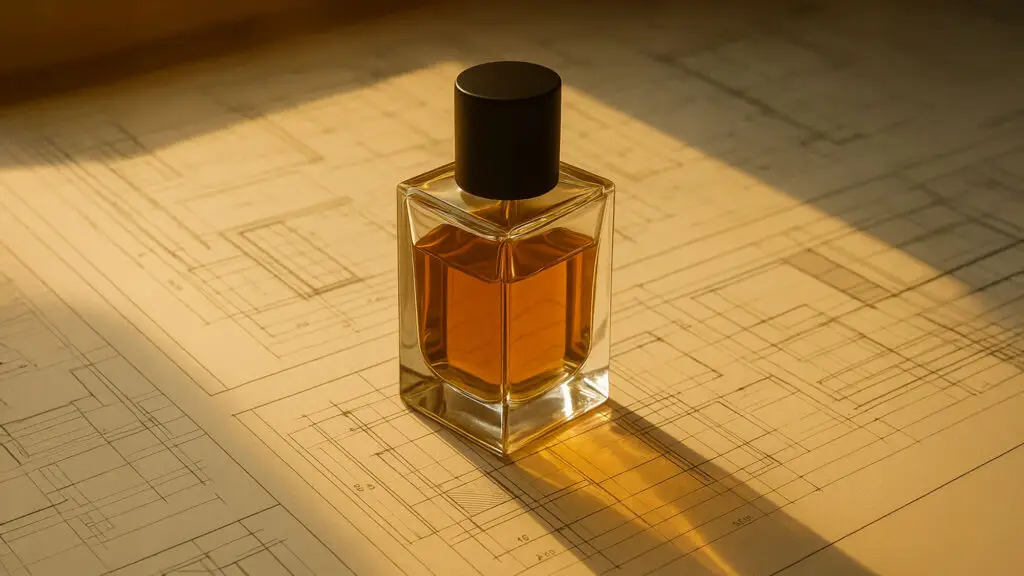
Foundation: The Blueprint of Emotion
Every fragrance begins with an intention — an emotion the perfumer seeks to translate. Much like an architect sketches a vision of space, the perfumer drafts a structure of scent. Fresh citruses or spices define the entrance, florals lift the mood like open ceilings, and the base — wood, musk, or amber — provides the foundation. The structure must stand; it must hold memory.
In design terms, this is balance — not symmetry, but harmony between volatile and enduring elements. It’s emotion given form.
The Verticality of Notes
Top, heart, and base notes create a vertical architecture — a scented skyline.
- Top notes greet instantly — they are glass facades and morning light.
- Heart notes are the rooms you live in — textured, nuanced, personal.
- Base notes are the structure’s bones — invisible, but vital to its endurance.
Perfumers, like architects, think in transitions: how light shifts, how air moves, how time alters experience. Each accord is designed to fade gracefully into the next, creating rhythm rather than repetition.
Materials, Texture, and Space
An architect selects marble, brass, and glass; a perfumer selects rose, vetiver, and oud. Each material has temperature, texture, and resonance. The success of both lies not in the abundance of elements, but in restraint — choosing the few that speak precisely.
The perfumer composes density and diffusion like an architect plans volume and void. What is left unsaid — the air between notes — matters as much as what is declared.
The Human Element
A building is not complete until it is lived in; a perfume is not finished until it meets skin. Skin transforms the scent’s chemistry — temperature, movement, and pH alter its projection. Thus, the wearer becomes the final collaborator, the living architect of the experience.
In The Shaukin philosophy, this interaction mirrors creation itself — design that adapts, refines, and becomes personal through presence.
Finishing Touch: The Legacy of Form
Great architecture and great perfume share a single truth: both endure through emotion, not scale. The structure of a scent, when designed with intention, becomes timeless. It doesn’t shout; it resonates.
To build a fragrance is to sculpt time — a quiet assertion that elegance can be engineered, and memory, by design, can linger forever.